Cairo
Opera House Main Hall, 6 May 2000
Duos de piano: Jouer a quatre mains et a deux
pianos, Jeffrey Grice and Laurent Cabasso, Cairo Opera House Main Hall, 6
May.
There is nothing that beats a piano, except perhaps, two pianos.
Unfortunately the vast dimensions of the modern concert grand and its
special sound-vibes sometimes make two pianos a bit too much. Even
four hands loose on a single instrument can mean the sound becomes
unclear, complex at the edges, with everything in danger of evaporating in
sheer volume.
With two individual pianos separated by space, things are
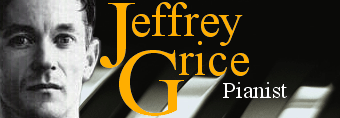
clearer. And the two players at this concert, Jeffrey Grice and
Laurent Cabasso, were alert to the two piano dangers. These players
on two instruments move in deep waters, churning up big ocean rollers fit
to sink a ship. But they also swim in shall seas, and the sounds
they make can be as delicate as a mountain stream.
Their sounds are very beautiful. Instead of what happens in this
sort of music, and aggressive din, we often had clear and intimate
sounds. So from the beginning to the end, it was a joyful
concert. The twin giants sang their duets like vocal melodies
instead of a wall of indistinct noise and in the Mozart that began the
concert, variations in C major, K501, the two players, really solists,
joined together at a single piano for their own pleasure. They were
strong, individual players and made an immediate impression of force and
difference of outlook, joining together not just for themselves but for
the audience. Clear was their intense desire to win sympathy for
their outlook as players.
It soon became apparent that Grice was histrionic. His thrust and
tempi were dominant, yet Cabasso was an eminence in his own right.
It was interesting how they brought their different tones and programmes
into such a sharp, immediate confrontation with the listeners. The
Mozart piece set a pattern of clarity followed throughout the
concert. Like the performance of another recent visitor to Cairo,
Victoria Kogan, it seemed each note sang sharp, clear but like crystal
belonging to the chain of musical phrase. Very soon the players had
the audience rapt and attentive.
The came Brahms, his variations on a theme of Haydn's. The
players opened this in grandly simple, spacious style, showing two pianos
are better then four hands. The so-loving atmosphere of Brahms was
spaced out with cathedral-like dimensions, informal but with immense
dignity.
Every part of the music was completely and clearly drawn. Brahms
the philosopher had been etched with diamond-like clarity and speed when
the mystery of gently rocking variations was reached. Everything
gradually dissolved into the air, even better than with an
orchestra. It brought tears of joy and hope, like a benediction
through the spaces of the opera house.
We had to make obeisance before the king of instruments. There
they were, the two large and massive creatures dissolving themselves into
sheer beauty for our benefit, with Grice and Cabasso as the willing
vessels of magic. The king was gone. No orchestra was needed,
nor performing maestro with a stick. Four hands and two pianos did
it all.
Brahms gradually gave way to Ravel's La valsem which is dome
leap. The piano growled its primeval, basso-profundo
tones. Like the Brando film, the music lurched drunkenly around,
communicating like decadent jewelry, flashing and fleshy. Both devine
and fear inducing, the waltz became an impulse to religious ecstacy.
Ravel's orchestra needs to be as explicit as the eye of the piano,
camera-like, is. Through a thunderstorm comes gunfire. La
valse makes its ascent into hell, shining brightly but deadly.
After a pause, during which we were able to resume equilibrium after
the waltz of the damned, we had more Ravel, this time the five pieces of
the Mother Goose Suite.
There is no gunfire in these sounds. Through veils of delicate
piano sound came the Sleeping Beauty, and then the other Beauty, of the
Beast, and finally the story ends in the leafy beauties of
Fontainbleau. The players even brought clarity to the fairy-tale
piece.
Last was Rachmaninov, with Suite No 2 op 17. It is a piece
of mystery and sleight of hand, or of four hands, really and two
pianos. It makes no difference, eight hands or two pianos, because
if Rachmaninov is in virtuoso mood, it is best to leave to be sure of
fresh air. His demands from the player and instrument are sadistic.
This strange piece was all finger and wrist, lightness and movement,
impossible speeds and yards or embroidery. The players coped with
everything. They never faltered.
There seemed to be military marches, never sweet or sugary, the players
moved through labyrinths of strange foliage, jungle-like and never
rational sounding.
Hopefully the pianistic colossus would gently unleash one of his hip
melodies for the listener. Finally he does. It's a strange
tune, large-limbed like everything about him - his feet must have been as
large as his hands. Grice and Cabasso went through this melody like
high-wire performers at a circus. One slip, after all, and you're
dead.
After an endless fluttering of four hands on two pianos, the
butterflies of Rachmaninov all melted away. The audience was left to
shout for more. The evening had been triumphant for Jeffrey Grice and
Laurent Cabasso. In spite of the fire and thunder of Rachmaninov, in
Brahms and Mozart they had even introduced silence.
- David Blake
May 6 2000 |